Sometimes events and circumstances allow people to make a special connection. This is what happened to us in Apataki with Alfred and his family. When we first arrived on the motu (small island) Phyllis and I were walking around the property and I noticed that there were two bee hives. I went over and made a cursory inspection and then moved on. Later on I mentioned the bee colonies to Alfred, the owner of the Apataki Carenage Service, and found out that he had just started beekeeping and didn't know very much about it or how to harvest the honey. This is very fertile ground for a beekeeper with 24 years experience so I, immediately, became enthusiastic to show him how to manipulate the bee colonies and harvest the honey. He had no extracting equipment so we went back to the very basic way of getting honey out of a comb without it. Basically, I uncapped the wax cappings with a fork and then squeezed the comb through a mesh screen. It worked out wonderfully and Alfred and his family were so happy to bottle all that honey that we became good friends. Over the next several days, I taught Alfred how to wire frames and examine the brood in his two colonies. He has ordered 10 more colonies and will be on his way to becoming a good beekeeper.
This connection gave us that special edge with this family and all Polynesian hospitality was extended to us. Every night we had fish grilled with rice and other fruits. Alfred's father grows vegetables and gave us some bok choy. He would not accept payment. In fact it became impossible to pay for these things.
The haul-out was very successful and we were able to paint the bottom with anti-fouling and put on new anodes. We relaunched on the boat on June 16th and went back to the mooring. We were liking Apataki so much that it was getting difficult to leave. We delayed sailing until June 21st when it was time to set sail. We motored the ten miles to Pass Haniura and made a quick exit with an outgoing current without difficulties. The Wx was fair with wind out of the SE @ 15 kts.
Thursday, June 28, 2012

Wednesday, June 27, 2012
APATAKI, TUAMOTU
June 11, 2012
We arrived of the Apataki atoll early this morning and checked out the North Pass which is called Pass Aimonu. We could have entered here but we were headed to another pass called Pass Haniuru which is located on the southwestern side of Apataki and is very well marked. There is a village there at the pass but we were headed into the lagoon and the Apataki Carenage Service haul-out facility. The best way to find out what the tide is doing in the passes is to eyeball it and see what it looks like. If it's rough with breaking seas and standing waves one has to wait for a more opportune time to enter. The currents can run 9 kts at times. If waves and heavy swells are breaking over the reef into the lagoon and aggravated by an opposing wind the water has to go somewhere- mainly out.
Today was a good day and things were smooth on entering the Pass. Once inside we could see the turbulence created by tides: water was bubbling and boiling with overfalls. Quite impressive!! So we motored on to the Tamaru motu inside the Apataki lagoon. Here is located the Apataki Carenage Service. There are five mooring buoys that can be taken on a first come first serve basis. For today we had to anchor and wait for a vacant mooring buoy.
This is a beautiful place and the family that runs the haul-out facility will be our most memorable experience during this leg of the voyage. Here one finds that wonderful Tuamotu hospitality. Basically there are seven people helping to haul-out yachts for storage or anti-fouling: Alfred, Pauline, Tony, Pappy, Nini and two others at times. Additionally, they have a pearl farm that produces those beautiful black cultured pearls that are so famous in the Tahitian markets.
We got on a mooring buoy the following day and were informed that we would be hauled out on June 13th. In the meantime, the family had fresh fish and other food that they served up during the evening. It was absolutely delightful to be there with sunrise and sunsets. The sky was inky black at night with stars blanketing it like a carpet. No pollution here! I have never seen a clearer atmosphere that in the Tuamotu. Everything here is on a self sufficient level. There are coconuts, fish, and some fruit. Everything else has to be grown. Water is from the rain and collected in plastic tanks. Electricity is by portable generator. There is no internet for the yachts, however, the family seems to have some kind of special subscription service the gives them access to the outside world. They are able to process credit cards and surf.
To be continued:
We arrived of the Apataki atoll early this morning and checked out the North Pass which is called Pass Aimonu. We could have entered here but we were headed to another pass called Pass Haniuru which is located on the southwestern side of Apataki and is very well marked. There is a village there at the pass but we were headed into the lagoon and the Apataki Carenage Service haul-out facility. The best way to find out what the tide is doing in the passes is to eyeball it and see what it looks like. If it's rough with breaking seas and standing waves one has to wait for a more opportune time to enter. The currents can run 9 kts at times. If waves and heavy swells are breaking over the reef into the lagoon and aggravated by an opposing wind the water has to go somewhere- mainly out.
Today was a good day and things were smooth on entering the Pass. Once inside we could see the turbulence created by tides: water was bubbling and boiling with overfalls. Quite impressive!! So we motored on to the Tamaru motu inside the Apataki lagoon. Here is located the Apataki Carenage Service. There are five mooring buoys that can be taken on a first come first serve basis. For today we had to anchor and wait for a vacant mooring buoy.
This is a beautiful place and the family that runs the haul-out facility will be our most memorable experience during this leg of the voyage. Here one finds that wonderful Tuamotu hospitality. Basically there are seven people helping to haul-out yachts for storage or anti-fouling: Alfred, Pauline, Tony, Pappy, Nini and two others at times. Additionally, they have a pearl farm that produces those beautiful black cultured pearls that are so famous in the Tahitian markets.
We got on a mooring buoy the following day and were informed that we would be hauled out on June 13th. In the meantime, the family had fresh fish and other food that they served up during the evening. It was absolutely delightful to be there with sunrise and sunsets. The sky was inky black at night with stars blanketing it like a carpet. No pollution here! I have never seen a clearer atmosphere that in the Tuamotu. Everything here is on a self sufficient level. There are coconuts, fish, and some fruit. Everything else has to be grown. Water is from the rain and collected in plastic tanks. Electricity is by portable generator. There is no internet for the yachts, however, the family seems to have some kind of special subscription service the gives them access to the outside world. They are able to process credit cards and surf.
To be continued:
Pictures of our wonderful stay in the motu of Apataki
 |
| A rock table at the reef side. |
 |
| Part on the motu of Apataki where we got hauled to get antifouling put on. |
 |
| A view of the landing of Apataki. |
 |
| We found the Apatak gold, Don was very excited and so was the owner Alfred who didn't have any idea on beekeeping. |
 |
| Wild flowers all over the island. |
 |
| Rabbits |
 |
| Coconut drying. |
 |
| Marie LaLou being hauled out. |
 |
| The finish work of our haul out, she looked really good. Don and I did a great job. Unfortunately we didn't have pictures of our haul out cause we had to be on the boat. |
 |
| This is the honey that Don and Alfred extracted from four frames of honey, and it is so good. It was extracted with primative tools But Alfred was very excited to have found real beekeepers and we were very excited to be able to help. |
 |
| One of many frames ready to be added back to the hive |
 |
| This our wonderful friend Alfred. This wonderful family open their heart and arms to us. It was very difficult to leave after spending12 days. |
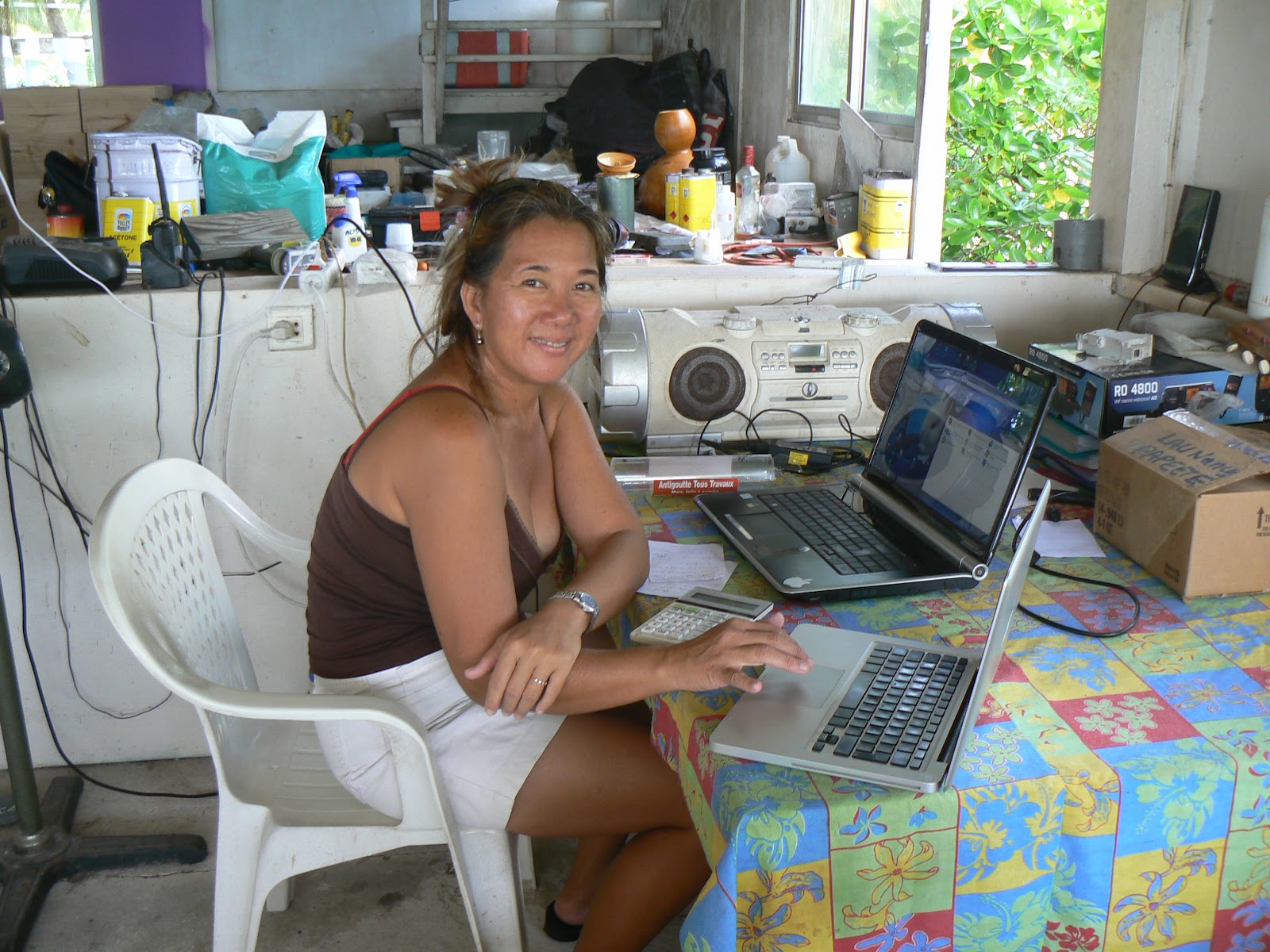 |
| Our dear friend Pauline, Alfred's wife |
 |
| Alfred and Tony their son grating papaya for the pouisson cru that they were teaching me out make. |
 |
| And here is the finished dish of Ceviche |
NUKU HIVA, MARQUESA ISLANDS TO TAKAROA, TUAMOTU
June 4, 2012
We weighed anchor a 1236 hrs in Daniel's Bay and set sail for Takaroa, Tuamotu. The wind was fresh out of the ESE so we had broad reach on the port tack. I had a reef in the mainsail and we averaged about 6 kts.
The Tuamotu atolls lie between the Marquesas and Tahiti. They are low and difficult to see under restricted visibility. In the days before modern electronic navigation they were called the "Dangerous Archipelago" or Low Islands. With view to making a safe voyage, Takaroa is chosen as a landfall because it is in the northern part with no land between. We had a good voyage but the winds went light and we were becalmed for several hours. We ended up poling out a jib and ghosting along. We made landfall in Takaroa on June 9th at 0830 hrs. Instead of trying to negotiate the tidal pass at Takaroa, I chose to lie ahull off the entrance and rest. The reason for this is that the currents in these atolls can be very swift and produce standing waves at the entrance. Additionally, one has to anchor in sand and coral. I didn't want to take a chance of getting the anchor chain wrapped around a coral head. Our goal was to get to Apataki, Tuamotu where we were planning to haul out the boat for anti-fouling and new anodes. We were travelling with another yacht called "Libertad" that were heading to Apataki. They anchored outside the pass but I was more cautious. Later they reported problems in getting the anchor up. Takaroa is another one of the beautiful atolls with white sandy beaches and coconut trees.
We sailed for Apataki on June 10th. The distance was about 95 nm so it was an easy sail.
We weighed anchor a 1236 hrs in Daniel's Bay and set sail for Takaroa, Tuamotu. The wind was fresh out of the ESE so we had broad reach on the port tack. I had a reef in the mainsail and we averaged about 6 kts.
The Tuamotu atolls lie between the Marquesas and Tahiti. They are low and difficult to see under restricted visibility. In the days before modern electronic navigation they were called the "Dangerous Archipelago" or Low Islands. With view to making a safe voyage, Takaroa is chosen as a landfall because it is in the northern part with no land between. We had a good voyage but the winds went light and we were becalmed for several hours. We ended up poling out a jib and ghosting along. We made landfall in Takaroa on June 9th at 0830 hrs. Instead of trying to negotiate the tidal pass at Takaroa, I chose to lie ahull off the entrance and rest. The reason for this is that the currents in these atolls can be very swift and produce standing waves at the entrance. Additionally, one has to anchor in sand and coral. I didn't want to take a chance of getting the anchor chain wrapped around a coral head. Our goal was to get to Apataki, Tuamotu where we were planning to haul out the boat for anti-fouling and new anodes. We were travelling with another yacht called "Libertad" that were heading to Apataki. They anchored outside the pass but I was more cautious. Later they reported problems in getting the anchor up. Takaroa is another one of the beautiful atolls with white sandy beaches and coconut trees.
We sailed for Apataki on June 10th. The distance was about 95 nm so it was an easy sail.
MARQUESA ISLANDS TO PAPEETE, TAHITI
May 13-June 27, 2012
It has been hard to keep the blog updated due to very poor or non-existent internet service. We made landfall on the island of Hiva Oa in the Marquesas on Mother's Day May 13th. Autuona which is the administrative center for the Marquesas is spectacularly impressive with steep jagged mountains covered with lush green. All of the Marquesas are impressive and very beautiful.
Hiva Oa was the last stronghold of cannibalism in the Marquesas and Robert Lewis Stevenson in "South Pacific Islands" describes an incident in 1864 where an American crew member from a Whale Boat was captured and only saved from being eaten by a missionary that ransomed him from the tribal chief. President Lincoln later sent him a sum of money and a gold pocket watch for this act of kindness.
We spent a week in Hiva Oa and then sailed for Fatu Hiva which is about 42 nm distant. This island is one of the last to make tapa cloth from the bark of mulberry, breadfruit and another tree. The islanders are good wood sculptors and make some beautiful wood carvings. Tattooing is an art form in the Marquesas and most of the inhabitants sport a few of them. When the missionaries wielded more power, the practice was forbidden but it is in vogue once again. Fatu Hiva may be the most beautiful island in all of the Marquesas but none are to be slighted. The locals were friendly and gave us a lot of fruit: mangoes, lemons, pomplemousse (a very sweet grapefruit), bananas. They would not take any money for this kindness. There are only two villages on Fatu Hiva that have anchorages. We anchored in Hanavave which was more protected but had strong katabatic downdrafts.
On May 22nd we weighed anchor and sailed to the island of Tahuata. On the western side there is a very beautiful anchorage called Hane Moe Noa. We dropped anchor and enjoyed the beautiful sunsets. The problem on many of the islands of the Marquesas are "NO-NOs". There are Black NO-NOs and White NO-NOs. They are similar to mosquitoes but rather than having a hyperdermic needle type bite, they take a small chunk of skin which can infect and make nasty sores. Fortunately, we avoided the areas where they mostly frequent and had no problems. This meant not going to many of the beaches or hiking inland during the hours of peak activity.
We followed Tahuata up with another island called Ua Poa. Hakehau is another delightful and beautiful town that had some vegetables and groceries. All produce and groceries are very expensive in French Polynesia. I would hazard a guess that the cost is at least double that of the States and in many cases more. All this gives the Polynesians a very high standard of living which is subsidized by France through all the taxes that are levied on all products. If one is looking for the romanticized allure of the South Pacific, you won't find it here. It's a very modern society with all the French and traditional customs mixed but more European than anything else. So far we have seen nothing that would indicate that Polynesians are anything but a modern society. I'm sure that on some of the more remote islands there exist some of the older traditions but we haven't been there.
From Ua Poa we sailed to Nuku Hiva and then Hakatea Bay (Daniel's Bay). Nuku Hiva is a good stop for groceries and limited repairs. We rented a car with another boating couple and toured the island. It was a very beautiful trip but the roads are no more than dirt goat paths in many of the places. Only a four wheeler could negotiate these places. One of the impressive sights that we saw in Taiohae, Nuka Hiva, was the feeding of the sharks by fishermen when they are cleaning the fresh caught fish. They throw the guts and skeletons of the fish into the water and it boils with big sharks right there at the pier. It was enough to impress me that I didn't want to go swimming in that bay, however, many locals swim at some of the beaches. Daniel's Bay was our last anchorage in the Marquesas; another picture postcard place with incredible views and sunsets. It would be hard to find a more impressive landscape than that offered by the Illes Marquises. These islands are all volcanic and geologically very young therefore they have very few coral reefs. In all of these islands, one has to be very careful with ciguatera poisoning. This is a very debilitating toxin found in fish that feed on the coral or are eaten by bigger fish. The toxins are accumulative in fish and people and can be fatal under certain conditions. The effects go from mild to severe and may last for several days or months. We eat only fish that the locals know are safe but it's not a sure thing. So far we have been lucky!!
It has been hard to keep the blog updated due to very poor or non-existent internet service. We made landfall on the island of Hiva Oa in the Marquesas on Mother's Day May 13th. Autuona which is the administrative center for the Marquesas is spectacularly impressive with steep jagged mountains covered with lush green. All of the Marquesas are impressive and very beautiful.
Hiva Oa was the last stronghold of cannibalism in the Marquesas and Robert Lewis Stevenson in "South Pacific Islands" describes an incident in 1864 where an American crew member from a Whale Boat was captured and only saved from being eaten by a missionary that ransomed him from the tribal chief. President Lincoln later sent him a sum of money and a gold pocket watch for this act of kindness.
We spent a week in Hiva Oa and then sailed for Fatu Hiva which is about 42 nm distant. This island is one of the last to make tapa cloth from the bark of mulberry, breadfruit and another tree. The islanders are good wood sculptors and make some beautiful wood carvings. Tattooing is an art form in the Marquesas and most of the inhabitants sport a few of them. When the missionaries wielded more power, the practice was forbidden but it is in vogue once again. Fatu Hiva may be the most beautiful island in all of the Marquesas but none are to be slighted. The locals were friendly and gave us a lot of fruit: mangoes, lemons, pomplemousse (a very sweet grapefruit), bananas. They would not take any money for this kindness. There are only two villages on Fatu Hiva that have anchorages. We anchored in Hanavave which was more protected but had strong katabatic downdrafts.
On May 22nd we weighed anchor and sailed to the island of Tahuata. On the western side there is a very beautiful anchorage called Hane Moe Noa. We dropped anchor and enjoyed the beautiful sunsets. The problem on many of the islands of the Marquesas are "NO-NOs". There are Black NO-NOs and White NO-NOs. They are similar to mosquitoes but rather than having a hyperdermic needle type bite, they take a small chunk of skin which can infect and make nasty sores. Fortunately, we avoided the areas where they mostly frequent and had no problems. This meant not going to many of the beaches or hiking inland during the hours of peak activity.
We followed Tahuata up with another island called Ua Poa. Hakehau is another delightful and beautiful town that had some vegetables and groceries. All produce and groceries are very expensive in French Polynesia. I would hazard a guess that the cost is at least double that of the States and in many cases more. All this gives the Polynesians a very high standard of living which is subsidized by France through all the taxes that are levied on all products. If one is looking for the romanticized allure of the South Pacific, you won't find it here. It's a very modern society with all the French and traditional customs mixed but more European than anything else. So far we have seen nothing that would indicate that Polynesians are anything but a modern society. I'm sure that on some of the more remote islands there exist some of the older traditions but we haven't been there.
From Ua Poa we sailed to Nuku Hiva and then Hakatea Bay (Daniel's Bay). Nuku Hiva is a good stop for groceries and limited repairs. We rented a car with another boating couple and toured the island. It was a very beautiful trip but the roads are no more than dirt goat paths in many of the places. Only a four wheeler could negotiate these places. One of the impressive sights that we saw in Taiohae, Nuka Hiva, was the feeding of the sharks by fishermen when they are cleaning the fresh caught fish. They throw the guts and skeletons of the fish into the water and it boils with big sharks right there at the pier. It was enough to impress me that I didn't want to go swimming in that bay, however, many locals swim at some of the beaches. Daniel's Bay was our last anchorage in the Marquesas; another picture postcard place with incredible views and sunsets. It would be hard to find a more impressive landscape than that offered by the Illes Marquises. These islands are all volcanic and geologically very young therefore they have very few coral reefs. In all of these islands, one has to be very careful with ciguatera poisoning. This is a very debilitating toxin found in fish that feed on the coral or are eaten by bigger fish. The toxins are accumulative in fish and people and can be fatal under certain conditions. The effects go from mild to severe and may last for several days or months. We eat only fish that the locals know are safe but it's not a sure thing. So far we have been lucky!!
We are back in internet access so here are a few pictures. I don;t remember were I left off and hope I don;t duplicate some pictures.
 |
| Getting ready for the sunset on the way to the Tuamotus |
 |
| Almost at sunset time, |
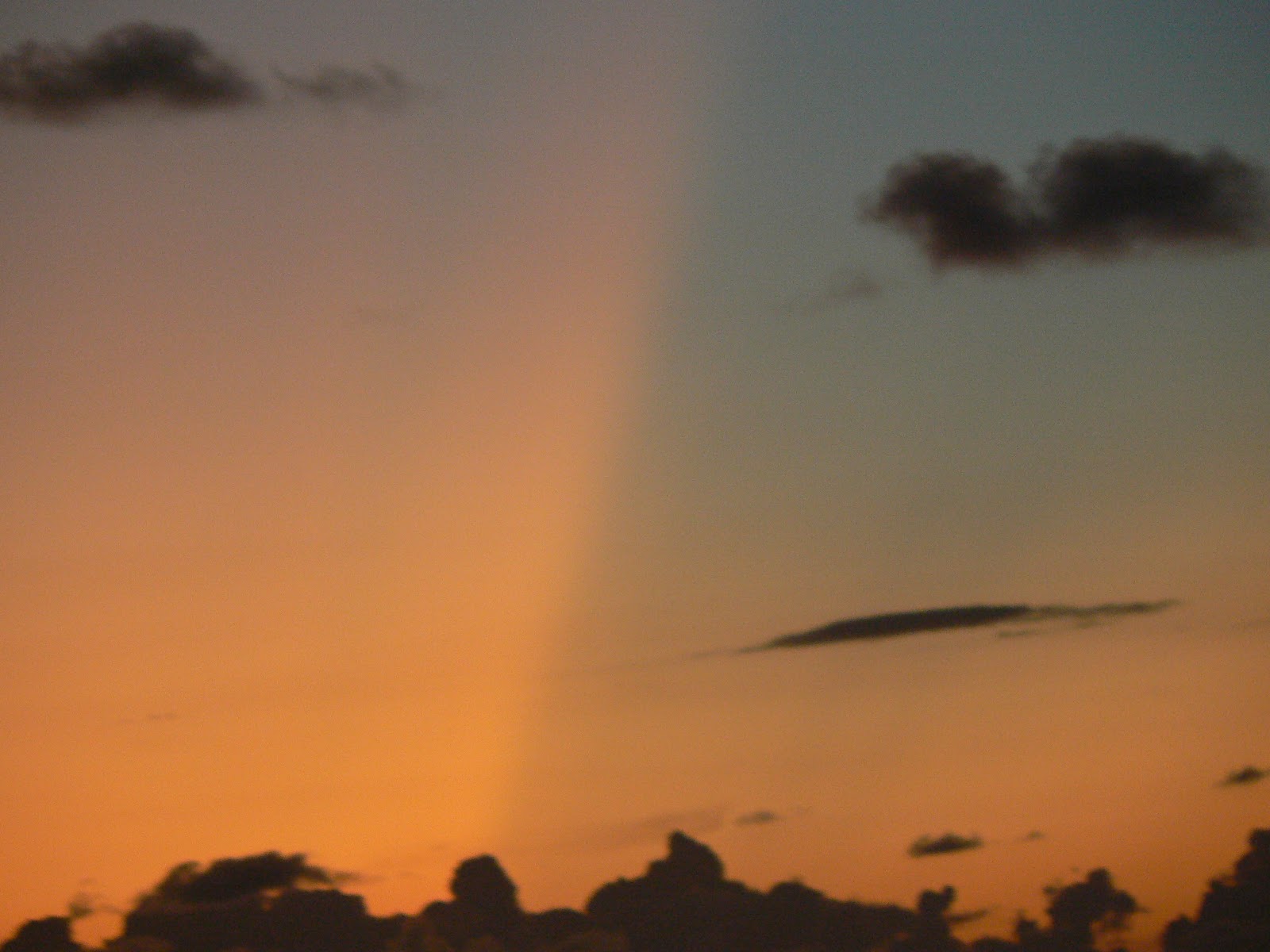 |
| The sun setting. |
 |
| A small Motu |
 |
| Going through the pass towards Apataki |
 |
| An outrigger keeping up with us as we move along at a speed of 4 to 5 knots. |
Friday, June 1, 2012
A few more pictures of the Marquesa Islands
 |
| Little pig on a line leash , fasinating I thought. |
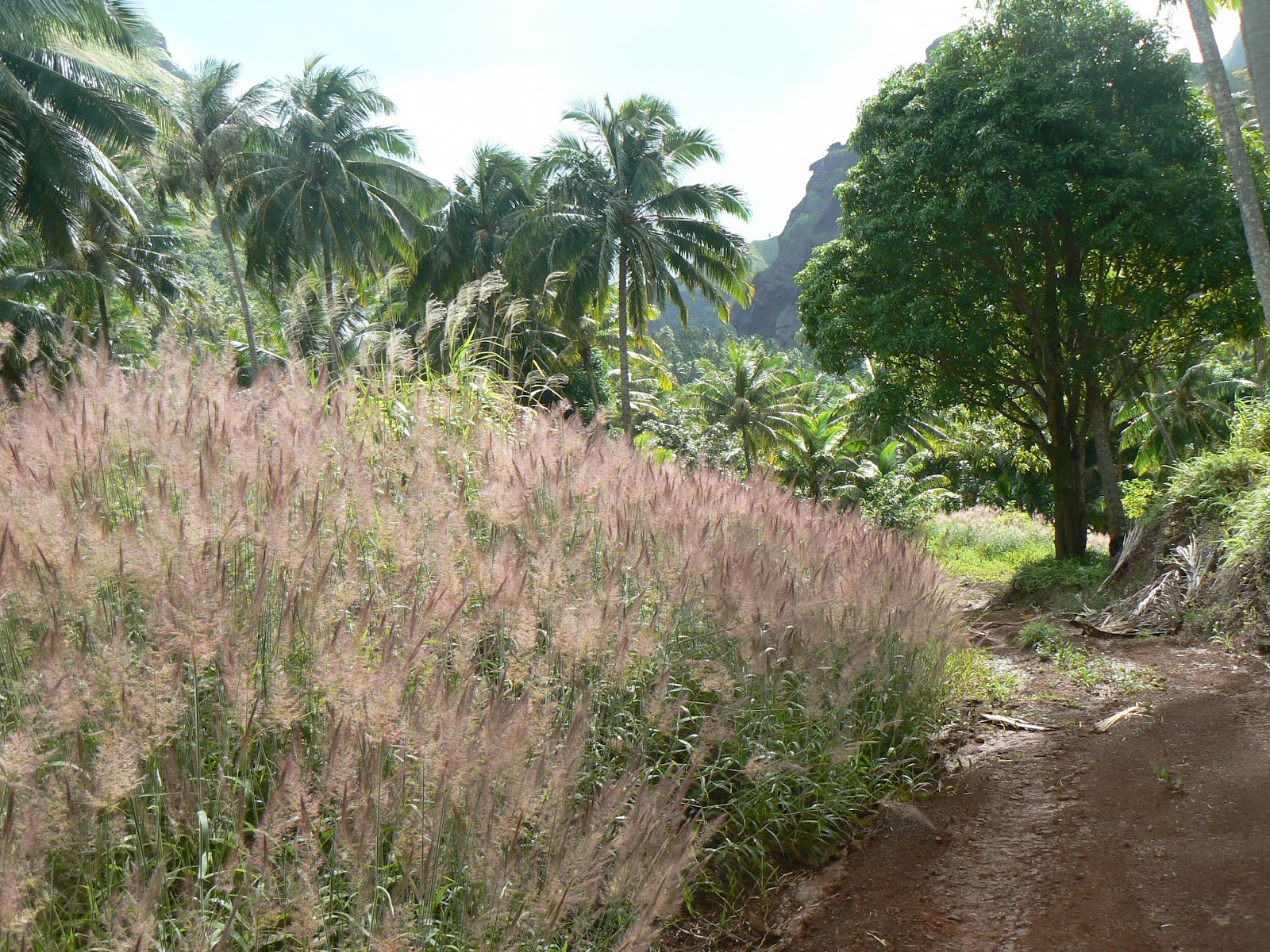 |
| Beautiful field of these feathery plant |
 |
| Another church |
 |
| Carrying an unfinshed out rigger to the water to assemble the out rigger. |
 |
| A coconut husking machine, and as you can see it does a pretty good job. |
Subscribe to:
Posts (Atom)