Friday, September 23, 2016

Our sailing trip on a dhow and more.

This is what it looks like and this is the dhow we went on.
A dhow is a typical sailing vessel that is use for fishing. Most dhows are under sail only. So we got to go on a sail on a dhow. We were four couples. What an awesome experience.  As you can see the sail is made out of whatever they can find. We've seen bed sheets, gunny sacks , table cloths,flour sacks, whatever they can find. It's  pretty amazing.
Same dhow different angle. 
This man was Paul's  helper. Paul is the captain.
This is .Paul
This man helps with the sail.

We are walking down to the dhow.
Kevin and Jacqui on the yacht Tin Tin.
Jacqui  and Sue.

That is quite a sail, but it works well.
We were 4 couples on this dhow plus the skipper and mate.
We sailed  to  an other part of Russian Bay for a hikE along the coastline,up a steep rugged climb and back down a steep rugged path. But it was amazing.


These are zebu. The local cow.

We were introduced to a local drink from fermented coconut resin. The man had to climb the coconut tree to get it.
Here he is straining  it and then we all got to try it. It was okay.

One of the village man is climbing the coconut tree to cut down young coconut for us to drink after our  long hike. It was very nice.


Here he's   cutting them open to drink the water.


Paul's 2 very handsome boys.


Just like the dads  dhow.


Beautiful Bougainvillea in front of their house.

Paul inside his simple but very nice home.
Another shot of the Bougainvillea. 
Sail is coming down, end of our wonderful experience  on the dhow. 

These two chair were in Paul's  house.
Just look at that sail and it works. 

We met this restaurant owner called Le Cataalan. We knew for sure he was Spanish.  We had two wonderful meals there and got to speak Spanish. The paella was great.
Don't need nuch to make it sail.

Hugh chameleon.

Different colored ducks.
Fishermen laying out their nets right by out boat.

Beautiful sunset in Nosy Komba where were anchored for a few days.


They have Crocodile s here. 

Pink frog.
Vanilla  plant.
The vanilla flower.

Cocoa pod. 
Aren't those mangoes beautiful, and boy are they good best we've ever eaten.
Land turtles all huddled in a circle. Pretty 

Le muria Land in Nosy Be and Lemur Land in Nosy Komba and more.

Beautiful lemurs also called Maki maki. This one has her baby on her back.
They are quite amazing creatures, very soft.
Petting the turtle.  He just loved it. As  I was petting it he stretched  his neck up.
We went to a factory  where they distilled very fragrant flowers called Ylang -ylang.  The women pick the flowers and then bring their picking  to be weighed. Then at the end of the month they get payed.
More maki makis.

Women lined up to deposit their picked and wait to have them weighed.

This is what the pickings look like.
All waiting.
Local girl selling jewelry.  We were on a tour of the Island and of course that was one of the stops. The Madagascar people make very nice wood carvings, beads , beautiful embroidery,  stitching. Each village has their own specialty. 
Nice work. Same below. 

And they also cultivate  bees.
We went to a place called the sacred tree. We all had to wear the local dress and take our shoe to visit the sacred tree. The picture is of the 4 couples on tour together. We are all on yachts going the same way. We all look pretty ridicules.

NOSY BE, MADAGASCAR

NOSY BE, MADAGASCAR
SEPTEMBER 6-23, 2016
We arrived in Hellville on Nosy Be (Big Island) on September 6th at 1000 hrs local (UTC +3) and dropped anchor in 30’ water depth in position:  13-24.412 S; 048-17.059’ E.  The holding is very good in thick mud;  Spring tides rise to 14’ and the bay drains out a long way.  The check- in process is not difficult but involves paying money to the Police and Port Captain.  In the past, the amount of money demanded by both agencies varied a lot; corruption is rampant in the government positions.  We did not find that the fees charged were different for the boats checking in at the present time:  they are Police (US$26) and Immigration (US$32 for a two month visa) , Cruising Permit for Nosy Be (US$20 for one month).  Sometimes, the Customs Official tries to extort a negotiable fee but has no legal right to do so.  We never saw the Customs Official.  Anyway, all these fees amount to a very small amount of money for most cruisers.  I don’t think they are negotiable and we received receipts for everything.  It’s important to pay the exact amount in the local currency or you may not get change back.  In September 2016 the exchange rate was US$1.00 = 3100 Ariary; 1 Euro = 3400 Ariary.

Upon going to shore for the check-in process, what is immediately noticeable is that the Malagasy have a different look from the Maldivian or Seychellois inhabitants.  The genetic ethnic mix is quite different:  SE Asian Malay-Polynesian and Bantu.  The men are handsome and many of the women strikingly attractive.  Some of the women wear the shortest skirts to be found anywhere in the world.  Unfortunately, the country is very poor and poverty is seen everywhere.  We haven’t noticed hunger or starvation but the Malagasy are not obese as seen in the Maldives, Seychelles and Mayotte.

The Malay-Polynesian customs and thatched huts are still very much a part of Malagasy life.  There are taboos (fady) in every village and island:  no washing clothes on Tuesday; no fishing on Thursdays; can’t eat pork from a pig with a straight tail; certain land areas; sacred trees, etc.  Every village and island has different ones.  It’s important to ask before venturing around because, if a “fady” is broken, the whole village may have to make rituals to appease the ancestors.  This is an animistic society, even though they may profess to be Catholic or Protestant.  I’m not sure how the Moslems react to this but they are not a significant force in the islands we have visited.
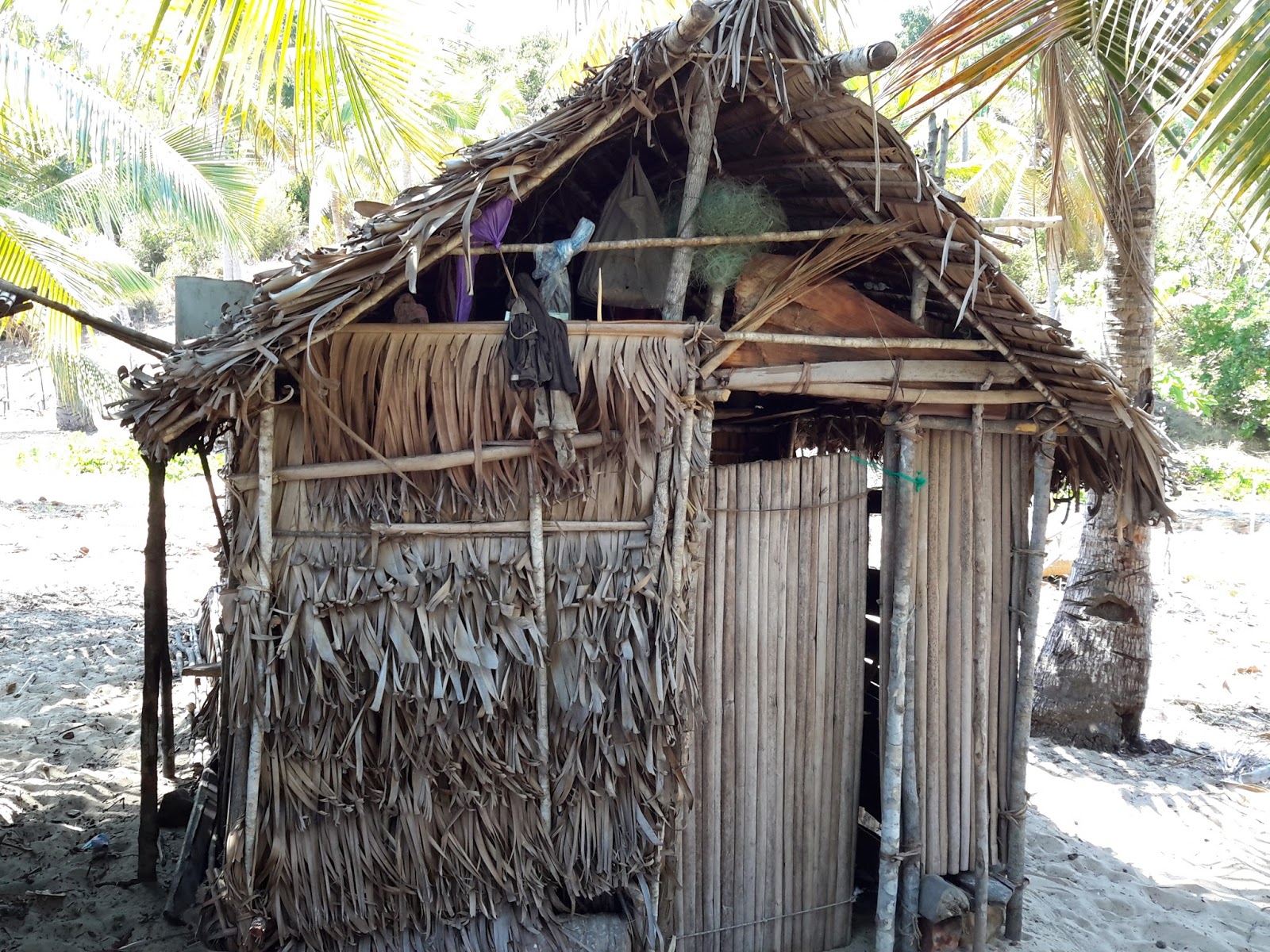
The Palm tree gives the Malagasy everything they need for building thatched huts.  Afterwards, the palm stalks are dried, then sawn and used as slating for the walls and floors of the huts.  They are using techniques from their Malay-Polynesian  ancestors that we have seen nowhere else.  Palm thatched roofs are the most common form on the islands.  The beautiful sailing dhows are a sight to behold.  They ply the waters without any assistance from an engine.  The sails are made from whatever is available and are in the most deplorable condition possible.  If there is enough money to buy cotton canvas, it will be the first choice for the larger dhows.  After that, the smaller ones use bed sheets, potato sacks, plastic, and any other material they can find.  Still, they sail fast using the local land and sea breeze: it alternates daily and makes sailing in the waters glorious.  The dhows carry an outrigger to stabilize the narrow hulls. 

In this county of ancient traditions and poverty, there is another world of wealth and privilege:  A very modern world with exquisite cuisine, luxurious resorts and all the other amenities that westerners enjoy.  Italians and South Africans populate this world with a smattering of other nationalities and the few yachts that make it here.  Given that the average wage for local labor is US$1-2 per day, the prices are the cheapest to be found anywhere.  The Malagasy government has failed its people from independence in 1960 to present day.  And yet, the Malagasy are a smiling, cheerful, friendly people that have great pride in their country and culture.  One feels perfectly comfortable walking through the villages; the locals neither stare nor make you feel uncomfortable. Amidst poverty, illiteracy, unemployment, and inadequate medical facilities, there is an underlying dignity in the people that is seen and felt by foreign nationals. If there is anything undesirable in this beautiful country, it is the fact that Malaria is widespread.  We have been told that Nosy Be and the outlying islands are under control but I question that.  I think they don’t want to scare tourists.
Given the fact that gainful employment is not available to most, the handicraft market and tourism is the main source of income.  They make beautiful embroidered tablecloths and clothes.  All kinds of utensils are made from the ZEBU:  the local cow with a hump on its back.  The meat is delicious but not as tender as Texas beef.  The horns are used in the various handicrafts.  The animal is used to pull ox carts and other forms of labor.  It is the single most tangible form of wealth that a Malagasy family has to display. This along with rice, chickens, ducks, coconuts, bananas, veggies and fish make up the diet of the Malagasy.  Rice is eaten three times a day.  Under French colonial rule, Madagascar was a rice exporting nation:  today, most rice is imported.

When one reads about Madagascar, Lemurs are the first thing that they come across.  There are 115 different species of Lemurs (Maki) in Madagascar.  They mostly live in troops of 5-25 with a dominant female.  In the national parks and game reserves, they will jump on your shoulder or head for bananas.  Their little paws have no nails and are very soft to the touch.  One always has a guide that is familiar with them and knows how to entice them to jump on the shoulders and head.  The next biggest draw is Rum.  The country has vast estates of sugar cane and distilleries.  Rum can be bought for a little as US$2 a liter with a mind numbing 104% proof.  As a matter of fact, most liquors, wines, etc. are quite cheap here.  Also, imported meats and cheeses are quite reasonable.  After the “Payschelles” everything seems to be cheap!  This really is a truly fascinating country.  We could spend a lot more time here but the season is drawing to a close and South Africa beckons.  It’s a pity that we didn’t sail from the Seychelles sooner but, in hind sight, given the weather that we encountered, we could have done it.

On Sunday or Monday, we will start the voyage South down the Malagasy coast to Moramba Bay:  14-53.3’ S; 47-20.4’ E.  This will take a while as we plan to day-hop from anchorage to anchorage.  Once we are in Moramba Bay, we will start to look for a “Weather Window” to cross over the Mozambique Channel and on down the East African Coast to Richards Bay, South Africa (28-49.0’ S; 32-06.0’ E).  This is the “voyage stopper” for many yachts as the Cape of Good Hope and surrounding waters has an infamous reputation for gales, strong winds and freak waves.  No yacht takes this voyage lightly; most prefer to travel in small groups in case something happens to one of them.


Sunday, September 11, 2016

MAYOTTE - AUGUST 27 TO SEPTEMBER 4, 2016

MAYOTTE
AUGUST 27 TO SEPTEMBER 4, 2016
We arrived in Dzaoudzi, the capital of Petite Terre, at 1230 hrs on 27 August 2016 and picked up a mooring buoy on the northern side of the Mayotte Yacht Club:  12-46.902’ S; 45-15.651’ E.  The mooring buoys are private but are available if the owner’s yacht is away or on the hard.  After picking one up, inquiries should be made about the feasibility of staying there.  If one has to anchor it will be in about 50’+ water depth and be quite far out because most yachts are on moorings.  The Mayotte Yacht Club is friendly and welcoming to transient yachts.  There are two showers, a washing machine, bar and free WiFi that has a strong enough signal to reach out into the mooring field.  The tides are over 10’ so it’s possible to careen a vessel alongside the Yacht Club wall and make repairs or have it lifted out and put on the hard.
Mayotte is a rather unremarkable place.  Other than decent French restaurants, good open markets with fresh fruit and veggies, well stocked supermarkets with a good selection of cheese, wine and meats, decent internet.  It just doesn’t have much more that would attract tourism.  There are two islands:  Petite Terre and Grand Terre; both are surrounded by a barrier reef enclosing a shallow and sheltered lagoon.   The channel is very well marked with buoys and ranges.  It’s about 16 nm from the northern entrance to the Dzaoudzi Yacht Club. Of the two, Petite Terre offers more for the average tourist.  It is made up of three townships:  Dzaoudzi, Labattoir, Pamandzi.  The airport is located here and it was the fortified capital the French chose because of its manageable size.  Grand Terre has Mamoudzou as its capital and is very much larger than its tiny sister.  The population is mostly Moslem but the administration and police seem to be largely white Christians. 
Geographically, Mayotte is part of the Comoros.  In 1974 and again in 1976, the general population voted to stay French and free.  The Comoros voted for independence and laid claim to Mayotte.  In 1985, all members of the UN General Assembly supported the Comorian republic’s claim to Mayotte.  Since Mayotte is French, its citizens are members of the EC and are entitled to the same benefits they would receive in France.  Almost everything is imported from France or South Africa and mark-ups vary from next to nothing to many times the original price.  Medical and dental care is free and prescription medicine is very cheap.  This has attracted illegal immigrants from the other Comorian islands and become a very big problem for the French administration.  There is little the Maore can do to control this.  If they round up any illegal Comorians, they have to pay the Comoros government to take them back and the same illegals will be on the next available boat back to Mayotte.  It is unclear why France wishes to hang on to this drain of its resources.
Visiting boats do not have to have visas for stays up to three months.  Upon arrival, one goes to Customs and then Immigration.  No stamps are placed in the passports and no “Clearance” is given for the next port.  One could arrive and depart without ever checking in!  The currency is the Euro and ATM are widely available.  Coming from the Seychelles, the attractive aspect of Mayotte is that the wind can be put on the beam or a little abaft rather that forward of the beam in big seas.  The enhanced wind corridor coming over the top of Cape d’ambre, Madagascar is hard to negotiate.  Mayotte offers a kinder solution.  After that, it’s only 200 nm to Nosy Be, Madagascar.

We departed Mayotte at 1200 hrs local on September 4th for Nosy Be, Madagascar:  210nm.  After the windy conditions we experienced coming from the Seychelles, there was very little wind on this passage but the NE’ly swells were coming in at 7’ and very uncomfortable.  We had to motor most of the way with just a few hours of sailing:  feast or famine.  It took 46 hrs to make this passage of 210 nm.  We dropped anchor in Hellville, Madagascar at 1000 hrs on September 6th.   

Friday, September 9, 2016

Hellville and Crater Bay

This is arriving in Hellville,  Madagascar  where we did our check in. We had finally arrived in Madagascar. 
Another scene of our arrival. 


Fishing boat under sail only no motor. The rest of the pictures are from Crater Bay where are anchored until tomorrow. 

This is a also a local big fishing boat with three sails.


 Coming back from early morning fishing.

More fishermen coming back from fishing in their  out riggers.

 Another type of out rigger with sails.

Their sails are basically  made out of rags sewn together,  anything they can put their hands on to make their sail.

Thursday, September 8, 2016

A little taste of Mayotte.

The market in the main island called Mamoudzou in Mayotte.

A beautiful view.

This flower is called Ylang-ylang 
It has a very  wonderful smell and they make perfume from it

Don is holding  the bark from the bamboo tree.

Don standing in front of the bamboo tree. It was Hugh. 
This was one of the prettiest flower in the botanical  garden we visited

The same flower getting ready to bloom.
Two different village we saw sailing  on the way to Petite-Terre, Ile Pamandzi .
Local lady .

The women wore very colorful clothing.


women picking star fruit from the Botanical garden on her way home.
I was trying to capture the colorful clothing again.

Tuesday, August 30, 2016

WINDY PASSAGE

SEYCHELLES TO MAYOTTE August 21-27, 2016
WINDY PASSAGE
On August 21st, we departed Angel Fish Marina, Roche Caiman, Mahe, Seychelles for Dzaoudzi, Mayotte.  This is not an ideal time to sail 800nm on a SW’ly heading.  The SE Trade winds are well established and blowing 20+ kts most of the time, however, occasionally there is a kink in the WX pattern that provides a window of opportunity to sail South in lighter winds.  It’s not often and can change dramatically once the voyage is started.  We have sailing friends on a 36’ Malo yacht that subscribed to a WX Routing Service called” Commanders”.  They have a good reputation for safely routing sailing yachts from one destination to another.  We noticed a WX window coming up and Commanders Wx Routing Service confirmed that there would be a “stable WX pattern over the next 7-10 days.  Based on that information, “Solstice” and “Norsa” completed all paperwork for clearing out of the Seychelles on August 21st bound for Mayotte.
Once the actual WX forecast was received, it wasn’t quite the same as had been predicted:  initially, the winds would be in the low to mid teens but increase to 25-30 kts!  Other complications in the WX forecast might produce even stronger winds.  This is not the stable WX forecast that was initially given.  The Valiant 40 and the Malo 36 are both heavy weather boats and can sail in these conditions so we decided to go for it.  We were tired of being in the “Paychelles” and wanted to move South to Mayotte and Madagascar.  We departed our berth at Angel Fish Marina at 0900 hrs on Sunday, August 21st.
A quick recap of the Ship’s Log gives the following:
August 21: 0900 hrs to 2400 hrs:  Wind was SE-SSE 10-15 kts and then 15-20 during the night.  Seas SE’ly 6’.
August 22: 0001-2400  Wind SSE 15-20; seas 6-8’.  During the night wind increased to 20+ kts.  We made good 153 nm from Noon –to- Noon.
August 23: 0001-2400 Wind 20-25kts; seas 8-10’.  Distance made good from Noon-to-Noon: 140 nm.
August 24: 0001-2400 Wind 25-30 kts with a rain squall to 40 kts; seas 8-12.  We are sailing under a double reefed main.  At 1530 hrs, we put a third reef  in the mainsail as wind is predicted to increase to with squalls.  Distance made good from Noon-to Noon: 143 nm.  The yacht is sailing very well in this beam on sea at 6.5 kts.  This is the first time ever that we have sailed in these conditions at this speed.  The boat remains remarkably dry with very few waves breaking onboard.
August 25: 001-2400 Wind increases 35-40 kts.  Boat starts to make 7.5 kts which is far too much so we reduce the genoa down to a “scrap of sail” and the speed drop to 6.5 kts; seas are in the 12’+ range.  The vessel is handling these conditions with ease and very little water is coming aboard other that spray.  Riding beam on to these big seas is an awesome sight.  Distance made good from Noon-to-Noon: 140 nm.
1800 hrs:  we reach the cross-over point on the top of Madagascar into the wind shadow and the wind and seas drop quickly and dramatically.  By 2100 hrs we have no wind and are motoring:  feast or famine!
August 26:  0001-2400  Wind  SE’ly < 10 kts; seas <3’.  Mostly motoring but set full main and genoa.  Distance Made good from Noon-to-Noon: 124 nm.
August 27:  Wind SE 10; seas 3’.  There is a strong adverse current 1 to 1-1/2 kts against us. The wind shifts more into the SSE.  We are not able to make more than 4.4 kts motoring at an economical fuel speed of 1800 rpms.
0600 hrs:  wind backs into the SE.  Set reefed genoa and start making 6.3 kts
0800 hrs:  In the Entrance Channel to Dzaoudzi:  17 nm to the anchorage.
1230 hrs:  Pick up a mooring buoy (12-46.902’ S; 045-1.647’ E) in front of the Dzaoudzi Yacht Club.
The total distance for this voyage was 805 nm in 147 hrs at 5.5 kts average speed.  It is one of the windiest voyages we have had since sailing from Tonga to New Zealand in 2012.  What makes this trip especially difficult is the “enhanced” Trade Wind corridor over the top of Madagascar.  A quick look at Windyty.com will clearly show this corridor.  One would have to be very lucky to sail from the Seychelles to Mayotte or directly to Madagascar without encountering it.  The amazing thing is that, once it is crossed, the boat moves into the wind shadow of Madagascar and conditions improve quickly.
The ideal time to depart the Seychelles would be in June, before the SE Trades are well established, or October during the transitional cross-over from the NE to the NW Monsoon.  There are problems with both of these times.  Vessels that are making the Indian Ocean crossing from the Maldives do not want to undertake the 1000 nm voyage through the ITCZ before the SE Trade Winds become established.  To do so means motoring most of the way.  That’s a lot of fuel to carry. The April departure will be a windless passage with the Equatorial Counter Current against you.  Depending on when the SE Trades move North to the Equator, May might be a good window or windless.  Vessels planning a stop in the BIOT Chagos archipelago will, most likely, stay the permitted 28 days and then, set sail from there.  Either way, the vessel ends up in the Seychelles close to June and has to make a decision to use that time frame to sail to Madagascar under favorable conditions.  Then what?  To Arrive in Madagascar in June and not be able to leave for South Africa until mid-October is a long time.  The longest that the Visa will be granted is for three months.  If one leaves the Seychelles in October, there is very little time to spend in either the Comoros or Madagascar before crossing over to South Africa.  Therefore, out of necessity, passages are made is less than ideal conditions.