Thursday, May 31, 2012

Pictures of scenes from the different Islands

The Tabernacle in one of the churches we visited


The pregnant Tiki watching over he children swimming in the bay.

Too cute.

Lonesome George
Mantas eating plankton by the side of our yacht.

Fraggle rock  for those who remember their kids watching Fraggle Rock Cartoons.

Have to include  my sunset.
Pulpit from another church.


Exploring with friends
One of the Bays in Hiva Oa

Saturday, May 19, 2012

We have landed in Paradise. The beautiful Island of Hiva Oa in the Maquesas. I will be showing pictures of the 25 day voyage on the high seas and when we arrived.

Beautiful flowers overlooking the mountains.

Arriving in the port of Hiva Oa.

Friends that left the Galapagos about the same time we did.
The first sight of the island.
Sailing with one sail on one side and the other on the other side called sailing wing and wing down wind.
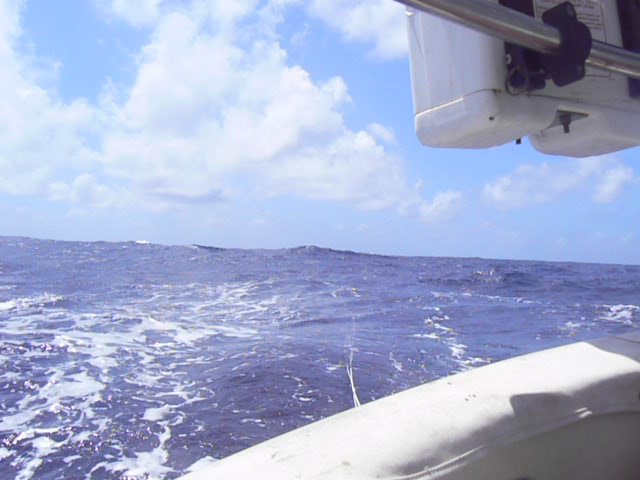
Rough seas.

Trying to capture the high seas.
Sun setting
Double rainbow
Full moon

ISABELA ISLAND, GALAPAGOS TO HIVA OA, MARQUESAS ISLANDS: 2950 NM

May 13, 2012  Sunday

We have made landfall on the island of Hiva Oa in Taahuku Bay (09 deg 48' S ; 139 deh 02' W).  This bay is the official anchoring spot for checking into French Polynesia at Atuona which is a 40 minute walk over the mountains.  The other option is to take a taxi which most cruisers do.  The entrance Hiva Oa is spectacular with very high mountains and precipitous cliffs and drop offs.  The island is lush and green.  Our first smell upon entering was fresh baked bread.  We anchored at 1100 hrs in a well protected anchorage behind a small breakwater.  Our voyage took 25 days with an average speed of 5.0 kts.  There is nothing here so one has to go into Atuona for entry formalities, groceries and money.  The scenery is absolutely fantastic and awe inspiring.!

The actual voyage had a distance of 3024 nm when tacking and course changes for the wind are brought into consideration.  The rhumb line distance was 2950 nm.  This was a long haul with periods of calm and light winds but mostly the South East Trade winds blowing from the ESE to E to ENE.  During the evenings squalls form and generate wind and rain.  Many of these produce gusts to 30 kts so we carried a single to double reef in the mainsail and reefed jib.  The beginning of the voyage from Isabela Island brought us SE'ly winds and a favorable SW'ly setting current so we were able to sail on a broad reach and make good time.  From April 18-24 we made good 858 nm in 148 hrs at 5.8 kts.  It was the fastest time for the trip.  After that we were becalmed and dropped all sails for about 8 hrs.  When the wind came back it was in squalls and confused seas.  Actually the seas were running about 8-10 ft in the main swell from the ESE with S'ly components and other swells colliding to make it feel like being in a washing machine.  Not a comfortable motion but the Valiant 40 is a very buoyant dry boat.

The farther South we sailed the more E'ly the wind became so that we had to set up sail for running before the wind.  This is usually done by sailing "Wing in Wing":  the mainsail is boomed out on the leeward side and the jib is poled out on the windward side.  It produces a fairly balanced sail plan and as long as there is enough wind to keep the mainsail pressed all is well.  Problems arise with this set up when there are big swells (8-10 ft), confused seas and light winds.  As the vessel dances around all wind is spilled out of the sail and it begins to flog and slate.  It's hard on the sail and equipment and nerve wracking on the sailors.  It the end we had to drop the mainsail because the flogging caused the base of the boom vang to be pulled off the mast.  I was able to overcome this failure by rigging up a handy-billy and 6 part block and tackle but we nursed our use of it for the rest of the voyage.  This left us with the headsail which I poled out either to port or starboard and managed to make 4.2 kts on average and 5.5 kts in squalls.  It's not comfortable sailing with only a headsail and it causes the boat to roll around even more without the stabilizing influence of the mainsail.  After this long voyage of sailing "wing in wing" I  realize that  Twin Headsails Poled Out" are the way to go when running before the wind.  Two time circumnavigator Scott Kuhner and his wife Kitty on the S/V Tamure had pointed out that I needed Twin Jibs but it was too late in the undertaking to do anything about it before we left the States.  When we get to New Zealand, it will be one of the first issues I address.  On this voyage it would have been possible to set the spinnaker we have onboard but I didn't have the experience to do it.  Although I know all the technical details to set it up, it's daunting to fly a big balloon sail in anything but light winds and settled weather.  We had squalls at night and I would never carry a spinnaker under these conditions.  That left me with daytime sailing and I didn't have the confidence to set it flying.  In the end I sailed a modified "wing in wing" with the staysail to leeward and the jib poled out.  Unfortunately, the staysail is too small for anything but heavy weather.  It's a scrap of a sail and does very little pulling.

The voyage was long, uncomfortable and not the idyllic sail I thought it would be.  The SE Trade Winds are not as constant as their NE counterpart.  Wx conditions and winds blow at different strengths within a small area.  I could be sailing with light wind and no squalls while another boat 60 nm South of me might have 15-20 kts of wind and heavy rain.  All this produces a confused sea that knocks the boat around.  After everything is said and done it was a good voyage:   we didn't have any severe or heavy Wx.  Our strongest winds and rain squalls were on the last day as we entered Hiva Oa.

The second piece of equipment to break during the voyage was the auxiliary alternator bracket.  Fortunately, it was dispensable and I can have it re-welded in  Nuku Hiva or points beyond.  


Monday, April 16, 2012

PUERTO AYORA, SANTA CRUZ TO VILLAMIL, ISABELA 48 NM

April 12, 2012

We sailed out of Puerto Ayora at 1645 hrs and had a light SE´ly breeze which allowed us to set the mainsail and jib.  This didn't last too long so we motor sailed at 3 kts to arrive in Villamil, Isabela in the daylight.  There are quite a few reefs that protect the harbor, however, the channel is buoyed to a certain extent.  I had purchased a detailed chart of Villamil from the Captain of the Port in Puerto Ayora.  The real world arrival in the port and what was marked and corrected on the nautical chart were quite different, however, it was enough to get us to a point where we could eyeball the anchorage and use the depth sounder for entering.  Also, we have noticed that the CMap charting program has to be offset for the Ports of Puerto Ayora and Villamil.  The electronic chart shows us on land in both places!  The charts that I bought at the Captain of the Port in Pto Ayora clearly stated that they were not referenced to the WGS 84 chart datum and had to be offset to by Latitude to the North and Longitude to the East.  I believe that CMap never made these offsets and used the non-referenced charts.

We arrived in the Port of General de Villamil at 0930 hrs and dropped anchor in 18 ft of water, on a sandy bottom, with 70 ft of chain out.  There are about 10 sailing boats in the anchorage preparing to sail for the Marquesas.

The island of Isabela is the least developed for tourists.  There are hotels and quaint restaurants but no ATM's.  The streets are still unpaved.  There are no asphalt roads.  Most tourists come over from Santa Cruz on fast boats for a day and then make the tours.  The biggest attraction is the Crater of Sierra Negra which is the second largest in the world according to the locals.  It takes five hours round trip to walk to the top and back.  There are horses available to get up there if it hasn't rained too much because the horses slip and slide.

Next up is the incredible breeding center for the endangered giant land tortoise.  Of all the islands Isabela had the most diverse species of Galapagos (giant land turtles): 6 different species.  The  breeding center has undertaken a program to re-establish the Galapagos that were threatened in the Southern part of the island.  The program is a stunning success and one sees these turtles everywhere outside the center of town.  This is a joy to behold!  Also, there are Flamingos in some of the lagoons as well as the marine iguanas.  Not too many sea lions here but they are around.  The famous blue footed and red footed bobbies are here but one doesn't see much of them.  We have only briefly glimpsed a few blue footed bobbies.  Several other birds that are unique to the Galapagos have been seen in our tours and hikes.

During World War II, the Americans had a small radar base set up on the island to monitor any Japanese plans that might threaten the Panama Canal.  This was complemented by additional bases on Baltra Island  off Santa Cruz and San Cristobal island.  When the war ended and the Amnericans left,  the Ecuadorean government, in 1948, established a penal colony of about 300 prisoners on the former American radar base.  The conditions were harsh and in order to keep the prisoners busy they were given the task of building a wall of volcanic rock.  Many died or were killed by the guards for not duirng enough work.  There is an incription on one of the informative signs the says, "Here is where the brave weep and the weak die."  This is the Wall of Tears: an absolute exercise in futility, uselessness and atrocity.

Isabela is the most beautiful of the islands for its natural beauty and fabulous sandy beaches.  Only the Southeren half of the island is accessible by dirt road.  The Northeren half requires a helicopter or boat to access some of the coves and harbors.  Goats, which once threatened the giant land turtles have been eradicated, however, pigs still remain a significant threat to the newborn turtles and eggs.  These are far more difficult to erradicate so the locals are encourged to hunt them.  It appears that the Galapagos on the Northern half of the island are not so threatened because it is so remote that the pirates, buccaneeres, whalers and sealers couldn't get to them so easily:  their populations remained viable.  Most of the turtles taken by ships were females because they didn't weigh as much so they were easier to carry.  A big male Galapago can weigh 400 lbs.  They use this weight to hold the smaller female turtles in place during copulation.  At this time they make loud grunting noises - perhaps, not so different form their human counterpart!!

The harbor is very well protected by the reefs that surround it.  It is clean and quite beautiful.  The shores are covered by volcanic rock and mangroves.  The undergrowth is very thick and difficult to impossible to penetrate without a machete.  There is a small pier and boat dock for water taxies and tour boats but no facilities for a yacht.

On Wednesday, April 18, we sail for Hiva Oa in the Marquesa Islands.  The port is called Atuona.  For those that wish to follow our progress from Isabela to Hiva Oa, go to the Pacific Seafarers Net and look up the Position Reports.  We will be giving our position report at 0330 hrs UTC which is 2230 hrs CDT and 2330 hrs EDT on 14300.00 Mhz SSB.  This will be posted on their website and you can access ourselves and all the other vessels reporting in.  The report will give you our Lattitude, Longitude, course, speed, wind, seas, cloud cover and barometer.  The voyage is about 3000 nm and will take us about 25 days.  The winds have been very light so we might have to sail South to 6 degrees to find those evasive SE Trade Winds.

Sunday, April 8, 2012

Pictures of the Charles Darwin Research Station and a few other different shots

Cactus tree native of the islnd
Beautiful bouginvilla  bush

Sunset in the Puerto Ayora anchorage

Another type of cactus
Marine Iguana

Another marine Iguana

Yellow land Iguana

Camouflage yellow guana

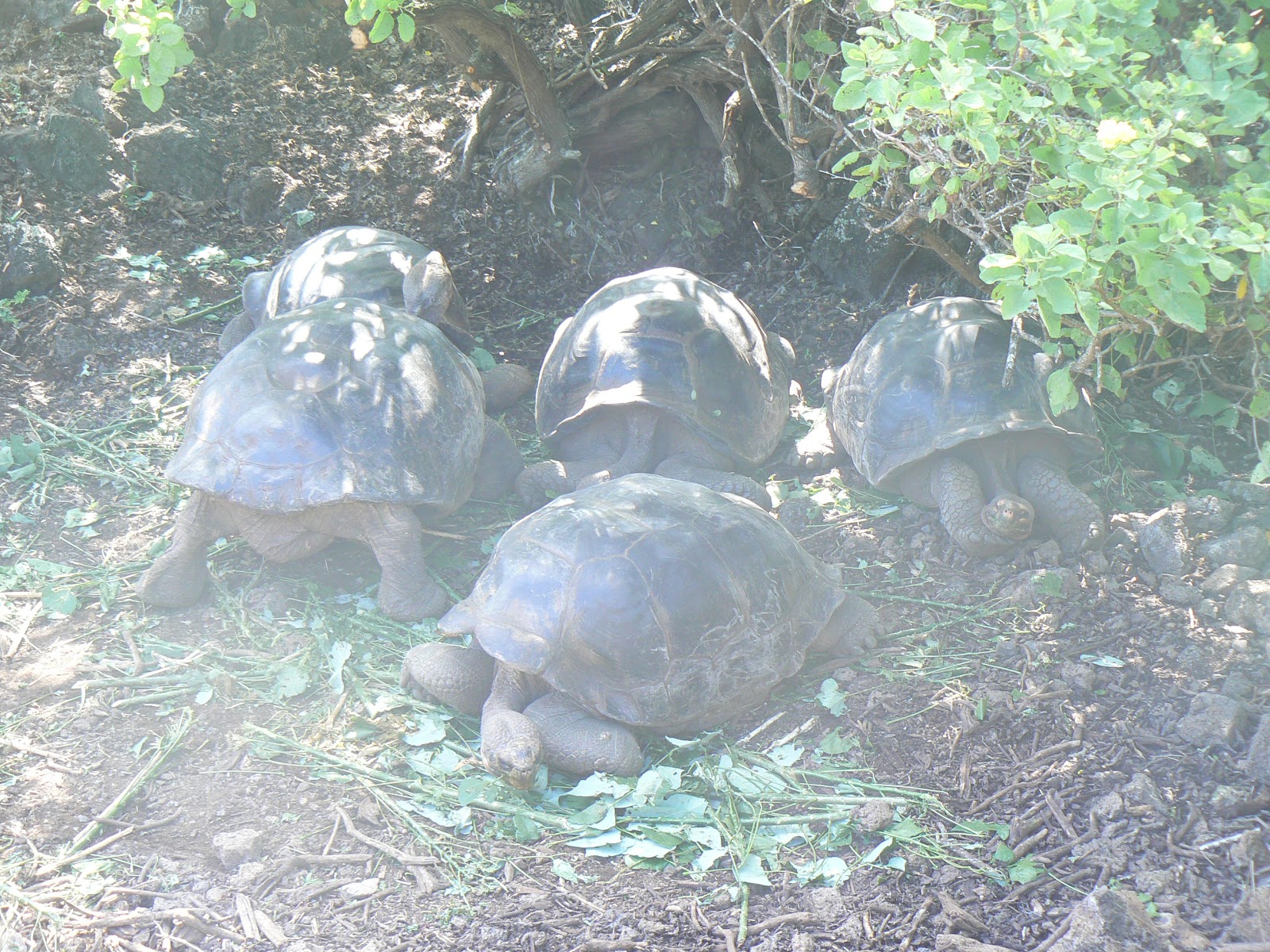
Giant land Tortoises

SAN CRISTOBAL TO SANTA CRUZ ISLAND, GALAPAGOS

April 4, 2012 Wednesday

The swell has started to go down so we set sail at 0700 hrs this morning for Puerto Ayora on Santa Cruz Island.  Once we got well offshore the seas were much less that in the harbor.  Also, we had a favorable NE'ly wind so we set sail and were moving along at 4.5 kts under main and jib. Alas, the wind backed into the NW and then the SW where it became a dead "noser"--motor sailing required to make Acadamy Bay by evening.  The distance from San Cristobal to Santa Cruz is only 42 nm but we had an adverse current slowing us down so we only averaged 4.5 kts with the engine and mainsail.  I thought there might be some growth on the bottom of the hull but I had just cleaned it a week ago.  We passed by Santa Fe island which is uninhabited and desolate.  There are many Cacti of the genus Opuntia that grows there:  this is a rather unique cactus because it grows in tree form with a trunk as it gets older.  Other than Cacti and birds, we saw no other animal forms while sailing along its barren shores.  There is a small protected cove on the NE of the island that Bluche, Le Tourmelin and, finally, Bernard Moitessier anchored in 1964 spending 6 weeks there with his wife Francoise.  This is no longer possible since the Galapagos National Park Service doesn't permit yachts anchoring on uninhabited islands.  The reason for this is the re-introduction of the almost extinct land tortoises and iguanas on these islands.  They can be visited with a special National Park Service Guide but this would be very expensive.  The other way to do it is via a tour boat.

Despite the motor sailing, the Wx was beautiful and it was a most pleasant trip over to Academy Bay.  We dropped anchor in the bay at 1700 hrs and enjoyed a fabulous sunset.

Academy Bay in Puerto Ayora on the island of Santa Cruz is the most populated island in the Galapagos.  Charles Darwin Station is the center for scientific research, breeding and reintroduction of the almost extinct tortoises, iguanas and other endangered species.  As a result, there are many more Europeans and Americans located here under the auspices of grants and funds from various organizations.  This, too, brings in a wealthier tourist arriving by plane and cruise ship.  As a result, there are more upscale hotels, dinning places and the ubiquitous jewelery stores and handicraft shops.  There is a lot more to do and see here than on San Cristobal but, so far, we like Baquerizo Morena more and miss the sounds and antics of the sea lions.  We have seen no sea lions here in the port but they do exist on the island.  Here are the blue footed bobbies, giant land turtles, terrestial iguanas and a more diverse flora and fauna.  The Charles Darwin Scientific Research Center has captured most of the endangered species and has them in special breeding and re-introduction programs.  They are doing a fabulous job of bringing back these almost extinct species.  There are thirteen islands in the Galapagos of which only four are inhabited.  In the 1700's pirates, buccaneers, whalers, sealers and others wreaked havoc on the existing wildlife.  The introduction of pigs, goats, cats and dogs just about finished off the job of decimating many of the endemic species.  The giant turtles were taken as food in the hulls of ships and then it was discovered that, in addition to food, they could be used for burning oil in lamps.  Thousands were killed until a point was reached that the species could no longer survive on its own.  In 1959, UNESCO and other organizations declared the Galapagos a World Heritage Site and the Ecuadorean government set up National Park Service.  Today, these efforts are paying off and most of the islanders are environmentally in tune with biodiversity and protecting what is left.  After all, if their most unique flora and fauna disappears so does all the income from tourism which is the most important source of income for most islanders.

There is one special land tortoise that is in captivity at the Charles Darwin Research Center.  His name is "Lonesome George".  He is the last surviving land tortoise from the island of La Pinta.  Most of these land tortoises lived around the craters of volcanoes.  Unfortunately for George, the crater collapsed and killed all the remaining females leaving only himself.  Many attempts were made to search the island for a suitable mate but in vain.  Today he is in a pen with other females from different islands but has shown no interest in breeding.  These turtles can live to be 150 years old and George is about 90 years old.  Unless he chooses to procreate, with his death, another species goes extinct.

Our mail has arrived at last.  We picked it up at the FedEx Office on Saturday.  We now have two anodes for the main engine that our friend, John, sent.  Now I have to find out where they go!! It's not obvious and difficult to see how to access this most inaccessible place.

Tomorrow we will start to organize a tour to see more of the island.  I don't know where this will take us.

Wednesday, April 4, 2012

DELAYED SAILING FOR PUERTO AYORA IN SANTA CRUZ, GALAPAGOS

April 4, 2012

We were up at 0530 hrs this morning in preparation for departing San Cristobal for Santa Cruz.  The Wx had deteriorated during the night so there was a big SW´ly swell in the anchorage with rain and squally winds.  Since we would have to set sail on a course of 274 degrees for Puerto Ayora and the wind and seas were out of the WSW at 250 degrees, it would be a dead "noser" to try and motor against 6-8 ft seas.  The theoretical sailing angle of a sailing vessel is 45 degrees off the wind to one side or another.  Most boats won´t point that high and require 50 degrees or so off the wind to make progress.  This is called sailing "close hauled".  It is as high as the sail boat can point into the wind and still make progress.  If the wind is coming out of the WSW at 250 degrees, the best we could do would be 200 deg. or 300 deg.  All that means that we would have to tack back and forth to get to our destination.  This adds a lot of distance to the voyage.  We need to make Acadamy Bay in Pto Ayora by late afternoon or lie ahull all night long waiting for daylight.  All in all--stay where we are until the weather improves:  that might be another 2 days.

Here is some info on restaurants and menus in Baquerizo Moreno.  The morning breakfast is pretty straight forward with eggs, coffee, toast and fruit.  The mid day meal is a "fixed price" affair with whatever the restaurant is serving that day.  It consists of a soup with a small dish of popcorn on the side, juice, meat or chicken, and rice and a small salad of lettuce cucumber, tomato and onion.  The average cost is $3.00-$4.50.  The higher end has a little more.  The restaurants are small "family run" deals, clean and good fare.  There are no gourmet restaurants here, however, there is a good selection of meat, fish and chicken that is very well prepared and delicious.  At the upscale end a meal will cost $8.00-$15.00.  On the lower end one can get fried rice, chicken or meat for about $3.50.  A large beer is $3.00.  There is one restaurant serving pizza: $18.00 for a large one or $10.00 for a small one.

Although the islands can grow a certain amount of fresh fruit and vegetables, it is at a premium and not enough to supply the general population.  Therefore, all food is brought in by cargo ships on a weekly basis.  We had the same thing on Fuerteventura in the Canary Islands.  There are two good bakeries in town.  One has a German theme and the other one specializes in sweets and "flan" (egg custard).  The German theme is marginalized and in no way bakes that great German bread we have all learned to love.  Also, they have croissants but they aren´t the great ones that the French bake.

If you buy meat at the local market, they will ask if you want it with bones or without bones.  With bones costs $2.25 per pound and without costs $3.50 per pound.  We asked for two pounds of meat with bones and they went over and cut off a beautiful chunk of beef  hanging from a hook and weighed that up so that it came to one pound.  Then they had a tray of beef bones and they weighed out a pound of those:  meat with bones!  Phyllis made a wonderful beef stew out of it.

The islanders are a very simple, polite and educated citizenry with no pretensions.  They are friendly, helpful and not in a hurry to get anyplace special.  There is no crime to speak of and thievery is almost non-existent.  Everyone knows everybody else living on the island.  A very relaxed place to live.  Fishing, snorkeling, diving, hiking and surfing are the main forms of entertainment.  Since the island is a national park, there are strict regulations regarding trash, recycling and other forms of disposal.  There are colored containers for each type of disposal: blue for plastic, orange for organic matter, black for general waste.  There are containers in some stores for the disposal of used batteries.  All used petrochemical products are handled by the garages and the one gasoline station on the island.  The place is unbelievably clean with everyone participating.  On top of all this are the sea lions which have taken over the beaches, parts of the maritime sea walk and any boat, dinghy or other surface that they can get on.  Since they are on the endangered list and, for the most part only on this island, they are tolerated by all and have no fear of people.  When walking along the seawall one has to thread their way through the hoard of sea lions that are totally oblivious to your presence.  Some of the large males let you know just how close you can pass by them but no one has been attacked or bitten that we have heard about.

Here we are until the Wx improves.